
the footprints we leave “huellas”

A Community Spotlight on Scott Jacobs

Somewhere Between Gates:
Scott Jacobs was somewhere between gates when his phone buzzed.
He was heading to Mérida, Mexico where he spends part of nearly every summer, where he has an adopted family and a city he knows by feel. His mind was probably already there, already walking the limestone streets, already thinking about what he'd cook when he arrived. The airport was just the in-between.
The message was from a former student. Someone he'd taught more than two decades ago. This student had been in his class when Scott was reading aloud from a book called The Prince of the Pond, doing all the voices, making the characters real the way a good teacher does when they forget they're performing and just become the characters. Somewhere in that classroom, in those ordinary afternoons, something had settled into this kid and stayed.
The student had grown up. Was building a family now. And when word reached them that Scott was retiring, they wanted him to know something. That his classroom had mattered. That the lessons, the way the room felt, the particular safety of those ordinary afternoons, had stayed with them. The student had come out as transgender in their adulthood and looking back, Scott's classroom had been one of the few places where being exactly who you were had always felt like enough. They had gone out and bought a copy of The Prince of the Pond to read to their own kids.
Scott has a word for this now, one he picked up in Mexico over years of summers spent learning the language from the inside out. Huellas. Footprints. The marks you leave in the ground as you pass through someone else's life. In English he might call them ripples, the way something small moves outward long after the moment has passed. But huellas is the image that stayed with him. You're walking, always walking forward, and behind you the ground holds the shape of where you've been whether you look back or not.
He hadn't known. Of course he hadn't known. That's the nature of huellas. You're already gone by the time they settle.
The plane wasn't boarding yet. He stood there with his phone and a message that took him to a time twenty-some years ago and thought about all the ground he'd walked across without ever turning around to look.

The Kid From Jersey
Scott grew up in New Jersey, which is where he has always belonged. He knows this because for four years his family lived in Macon, Georgia, and the whole time something felt off. Not hostile exactly, just not true. There were things about the South that didn't line up with whatever was already formed inside him, and when the family moved back north he felt the relief of that without quite having the words for it yet.
He was a quiet kid in a lot of ways. Not many friends, some learning challenges, a home that was getting louder as his parents moved toward divorce. So he put his head down and worked. School became the thing he was good at, the place where effort produced results he could see and hold onto. He wasn't the kid with the big social life or the effortless confidence. He was the kid who showed up, paid attention, and figured things out by working harder than everyone assumed he needed to.
Those habits followed him everywhere. To college, where his Spanish professor pulled his mother aside one day and said her son seemed to have a real aptitude for the language. To the overnight summer camps where he worked with kids before he ever set foot in a classroom. This was the beginning of what would become 38+ years of his life spent working with young people.
He taught fourth grade for thirteen years. He was the kind of teacher who thought carefully about what he put in front of kids, who believed that a classroom could be a place where children learned not just curriculum but how to understand the world and help shape a better future for it. He ran a series of lessons on social problem solving where his students identified real issues that mattered to them and wrote letters to the editor of the local paper. The mayor wrote back. The kids were stunned that someone had listened.
He was passionate about teaching in the way that some people are passionate about things they were simply built for. He pursued his masters degree, then his doctoral studies, not because someone told him to but because he wanted to be better at the thing he cared most about. Every new idea was something to bring back to the classroom, something to test, something to refine.
Then one day his administration asked if he'd be interested in building the school's Spanish program from scratch. He said yes before he had any real business saying yes. His Spanish at that point was conversational at best, a single summer of study in Guadalajara years earlier. But that's the thing about Scott. He doesn't wait until he's ready. He says yes and then figures out what ready looks like.
He booked a trip to Mexico that summer. And then the next. And then the one after that. What started as professional necessity quietly became something else entirely, something he couldn't have predicted when he first landed in Guadalajara as a young man who just wanted to be able to teach his students something real.
He had no idea what was waiting for him in next trip to Mérida.

The Family Found
The first time Scott spent real time in Mexico it was overwhelming in the best possible way. His Spanish was functional but far from fluent, and there was a lot he couldn't follow, a lot that moved too fast or sat just outside his reach. But the people around him were patient in a way he hadn't expected. Patient and genuinely warm, in a way that felt different from the transactional friendliness he was used to navigating back home.
He fell into a routine quickly. Down the street from where he was staying in Guadalajara there was a small restaurant, the kind of place that doesn't advertise and doesn't need to, where they served flan that cost almost nothing and tasted like someone had been making it the same way for forty years. He stopped there every day. Sometimes more than once. He would sit with his flan and practice listening to the conversations around him and feel, slowly, the language beginning to open up.
That was the thing about Mexico that kept pulling him back. Not just the food or the warmth or the ancient cities rising out of the jungle. It was the feeling of being genuinely present in a place that required his full attention. Back home he could move through a day on autopilot. In Mexico he had to pay attention to everything, which meant he was actually living inside each moment rather than just passing through it.
He found Mérida eventually, the capital of Yucatán, a city of wide boulevards and crumbling colonial architecture and a pace of life that operates on its own logic. He found a family there too, one he had not expected and could not have planned for. A mother who cooked the way some people pray, with total devotion and complete confidence, who let Scott into her kitchen and let him teach her new recipes in return. He showed her how to make fresh pasta from scratch. She taught him things about flavor and patience that no recipe could contain. Those afternoons in the kitchen are among the memories he returns to most.
The mother was a religious woman, and she was honest with Scott early on about where she stood on certain things. He took note and didn't make it a conversation. What happened instead, over the summers that followed, over shared meals and long conversations and the ordinary accumulation of time spent close to people, was that she simply changed. By the time Scott's partner visited Mérida she welcomed them both with the full warmth she gave everyone she loved. And when that relationship eventually ended, she grieved it alongside Scott the way you grieve something that hurt someone you care about.
He never pushed. He just kept showing up as himself. That was enough.
Scott learned other things in Mexico too. He learned to loosen his grip on time, which did not come naturally to a man who had spent decades running a classroom on a schedule. He learned that strangers will help you if you ask, that a few words of genuine effort in someone's language open doors that fluency alone never could. He learned to walk through a city and greet the people he passed, something that feels radical in suburban New Jersey and completely ordinary in Mérida.
He spent summers at archaeological sites and cenotes, in the thick humid air of the Yucatán jungle, watching the way ancient things persist. He was in Mérida for Día de Muertos one year and stood in the streets watching the parades and the altars and the installations that filled the city, the way an entire culture turned grief into something luminous and communal and alive. He thought about the people we carry with us. He thought about huellas.
Mexico gave Scott a version of himself he hadn't known was in there. Looser. More present. Less afraid of walking into a room where he didn't know anyone and starting a conversation from nothing. He had practiced that so many times, with strangers on street corners and families who took him in and students he invented reasons to talk to so he could sharpen his lessons back home. By the time he returned to New Jersey each fall he was a slightly different man than the one who had left.
For all that Mexico gave him, he always came home to New Jersey. And home, for most of his adult life, meant coming home to someone."

Just Scott
For most of his adult life Scott's identity had been quietly organized around being part of a couple. Not in a way he had chosen consciously, it was just the shape his life had taken, the way a long relationship becomes the architecture you move through without noticing. His social world, the way people knew him, the way he knew himself in relation to others, much of it was built around being half of something.
When that relationship ended he had to figure out what the other half looked like on its own.
He wasn't dramatic about it. That's not Scott's way. But he was honest with himself that something needed to change, that the version of his social life that had existed inside the relationship wasn't going to sustain him now. He needed to find his own people. Not as part of a couple, not as someone's partner, just as himself, which turned out to be a more unfamiliar feeling than he had expected.
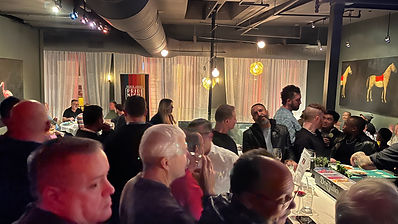
He started looking. A search on Google, maybe Facebook, the kind of low-stakes browsing you do when you're not entirely sure what you're looking for but you'll know it when you see it. Somewhere in that search he found a coffee social. An LGBTQ+ gathering, casual, no agenda, just people showing up to be in the same room together. It was happening in New Jersey, not far enough away to be an obstacle, not so close that it felt too easy to talk himself out of.
He decided to go.
February 2024. He walked in not knowing a single person in the room, which for someone who describes himself as shy is its own quiet act of courage. He didn't know what to expect, whether there would be cliques already formed and calcified, whether he'd spend an hour on the periphery nursing a coffee and leave feeling more alone than when he arrived. That fear is real for a lot of people. It was real for Scott.
It didn't go that way.
The room was easy. The people were laidback and approachable in a way that surprised him, not performing friendliness but actually friendly, actually interested. Someone came and talked to him. Then someone else. The conversations weren't forced or awkward, they just happened the way conversations happen when the conditions are right and nobody is trying too hard.
The first person he met that day became a real friend. Not an acquaintance, not a familiar face at future events, a genuine friend. He has others now too, people he has come to know over the months of showing up, the kind of friendships that form slowly and then one day you realize they're load bearing.
He still makes the drive every month. It's not the closest thing to his house. He goes anyway.
What he found at that coffee social wasn't just a way to spend a Sunday morning. It was a place where he could practice being himself again, outside the context of a relationship, outside the classroom, outside every role he had spent decades inhabiting. Just Scott, talking to people, finding out who he was when nobody already had a fixed idea of the answer.
He had been leaving huellas his whole life without knowing it. It turned out that’s what he needed, after all that time walking forward, was somewhere to stop and let other people leave a few on him.

Huellas
Scott Jacobs has spent most of his life walking forward without looking back. That message in the airport stopped him in his tracks, not because he had been waiting for it, but because it reminded him of something he already believed and rarely got to see confirmed. That the ordinary things, the lessons, the room he created, the care he put into showing up every day, travel further than you know. That somewhere out there the ground still holds the shape of where you've been.
That is what drives him. Not the proof of it. Just the doing of it.
He thinks about this in the context of teaching, which was the most obvious place he left his mark. Thirteen years of fourth grade, then a Spanish program built from nothing, then the doctoral work, then all of it filtering back into a classroom full of kids who had no idea they were learning from someone who had spent every summer in Mexico making himself a better teacher for them. You never know, when you're standing in front of a room of eight year olds reading aloud from a book, which one of them is going to carry something home that they'll still be holding twenty years later.
He thinks about it in the context of Mérida too. The friends he made over years of showing up, summers of pasta and cenotes and Día de Muertos and conversations in a language he had to work for. The mother who welcomed him into her kitchen and changed not because anyone argued her into it but because she knew him. The version of himself he found there and carried back to New Jersey each fall. Connections leave marks in both directions. That's the thing about huellas. You leave them and you carry them.
And he thinks about it now, on the second Sunday of every month, driving to a coffee shop in High Bridge, New Jersey with people he didn't know a year ago and can't imagine not knowing now. The friendships that formed slowly and then all at once. The room that turned out to be easier than he feared. The simple, underrated thing of showing up somewhere and being met.
He is building something again. Not a curriculum, not a language program, not a life organized around a partnership. Just a community, one conversation at a time, one month at a time, the way he has always built the things that matter to him. Quietly, consistently, without needing to see the whole shape of it yet.
Somewhere out there a former student is building a family and thinking about a classroom that felt like enough. Somewhere in Mérida the memory of a woman lives in a pasta recipe she learned from a man who came back every summer because he couldn't quite stay away.
Somewhere in New Jersey a person Scott hasn't met yet will walk into a room alone for the first time and find it easier than they expected.
He won't always know about it. That's always been fine.
The footprints don't need a witness. They just need someone willing to keep walking.


